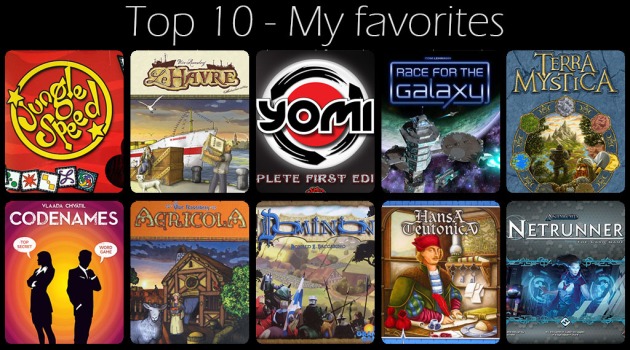
Top 10 – My favorites

For different reasons these are my favorite games (at the moment)

Contenders: Puzzle Strike, Carcassonne, Neuroshima Hex, Fields of Arle, Puerto Rico

 10. Jungle Speed – I can’t find players brave enough to challenge me at this game. Filthy casuals. So the game got boring to me. 😦 If I had players good enough I’d play this all the time.

9. Le Havre – Extraordinary Euro-game with so many and hard decisions each turn. I like that it forces me to plan ahead my turns.

8. Yomi – As a fan of Rock, Paper Scissor, I had to love this game. The game can looks very simple, luck based, and casual, but it’s actually one of the most complexes game I played, and is so deep.

7. Race for The Galaxy – A multiplayer solitaire with almost no downtime? Sign me up. A game can last for half an hour and at the end for the amount of things I built and amount of decisions I had to make I feel I played for much longer.

6. Terra Mystica Super strategic. So many different races to try different strategies.

5. Codenames – A party game that makes you think, and forces you to discover what’s the best to say in each turn.

4. Agricola – Best example of a worker placement. Lesson on how to make a game.

3. Dominion – One of the most addicting games I ever played. I love games that make you try new strategies each game.

2. Hansa Teutonica – Perfect game!! The most clean and excellent euro game there is. All games start the same yet all games are so different. Super competitive. (I advise you all to play the Britannia expansion)

1. Netrunner – I love to come up with combos and make decks, and can’t think of a game with more possible synergies and combos to explore. One of the problems is that it’s an open game and to play in a competitive level you should to keep buying the expansions. So I can see how it’s a hard game for newcomers to start, cause the complexity level is quite high at this point. But if you give it a chance is worth it so much! How many nights I fall asleep thinking about new decks.

top 10 - favorites

Essen 2013 games – first impressions

Caverna: The Cave Farmers (after 1 play w/ 5 players)

caverna

  • The game is not the same as agricola. They share the same main mechanic but the different details make them very distinct.
  • People who will love this game are not the same people who love Agricola. I love agricola and found Caverns to be a good game but not as good as Agricola for sure. But the others guy’s at my table all loved this game.
  • I really miss Cards in my hand. I like to have my private buildings much more than a shared pool of buildings.
  • Also I didn’t enjoy the expeditions cause they do (almost) everything, so the players who are using them are not forced to plan ahead their actions cause this action is so flexible.
  • Don’t get me wrong I really enjoyed the game, but comparing it with agricola it’s a worst game. Agricola is much more elegant.

Russian Railroads (after 1 play w/ 4 players)

russian

  • I was very well impressed with this game. It gave me a very good sense of evolution and that the order of wich I evolve my railroads is a main aspect of any strategy.
  • First few actions are scripted for each round (at least the first action is always to get an engineer)
  • Maybe it scales little too much in the last rounds. In one turn you score 40 points, next turn you score 80 points…. I’d prefer if it were less focused in this sum of points. Maybe with a completely different kind of score.
  • But as I said it was a very good experience and I’m willing to play it again when I get an opportunity. (still a few friends of mine advised me already that the replayability in this game is not that good, and I can see that..)

Nations (after 1 play w/ 3 players)

nations

  • I had already read that this game replaced Through the Ages for some people. And I must admit I agree with them. It’s a similar game with huge advantages for me: less setup time, less play time, more clean and straightforward mechanics, no runaway leader, and better player interactions. I just prefer the card drafting of TtA.
  • Is a strategic game with very tight decisions. The growth step is so important and hard do decide if you want worker or resources.
  • Must say that the event cards don’t add up as many luck as others can say, cause you already know that to do good on them you always need stability and military force.
  • Loved the restrictions of how many cards you can have of each type. And the final scoring is also so clean.
  • Little note about the handicap system wich is something that I’ve never seen before in any boardgame and is very interesting.
  • Was not expecting to like so much of this game (I like TtA but I’m not a big fan) so was a very good surprise and the best game I’ve played from Essen.

Glass Road (after 1 play w/ 2 players)

glassroad

  • A typical Rosenberg title where you gather resources, build new buildings, build some combos and try to get points as many points as possible.
  • The twist in this game and what makes it unique is the way how you chose your actions. If Agricola and Witch’s Brew had a child it would be GlassRoad.
  • In this game you have time for nothing, your number of actions is so tight wich makes each one of your action so crucial. Cause of that and the simultaneous selection of cards to play each round, the play time is very short, and I like that.
  • Rules are very simple and easy to grab.
  • A very interesting and unique game. I recommend it, and want t play it more.

Tash-Kalar Arena of Legends (after 1 play w/ 2 players)

tash

  • An abstract game from Vlaada Chvátil? Had high expectations for this one.
  • The rules and mechanics are much more interesting than the game itself.
  • The game is VERY Chaotic and 99% tactic, there’s no space for strategy.
  • I think this game is a pro at generating AP amongst the players, and I hate that!
  • Is an interesting game with good concepts but was still not good enough to be released.

Games I’m more interested to play next:

Amerigo

Bruxelles

Lost Legacy

Machi Koro

Madeira

LisboaCon and Netrunner

The 4th edition da LisboaCon starts tomorrow. Saturday and Sunday you’re welcome to join in and play boardgames.
Is available a large collectin of boardgames available to play, an area for RPG’s, tournaments, and a shop. It is a free admission event and have people available to explain rules of the games you want to try.

Also don’t forget about the Netrunner tournament for which I am the Tournament organizer and is scheduled for Saturday at 15h. Tournament rules and prizes here.

About games price

Many times I find articles on BGG of users complaining that a certain game is not worth the price since the components are of poor quality and that money should have much better components. There are comments like “The game is very good but with these components is not worth to purchase.”.

We’re buying a system and not a bunch of nice bits
We can think about this: When we buy a game we are buying the work of several people with the most obvious being the game designers and artists. Looking only at the components to set a price is a wrong method. There are games which take much more time in development and testing than others and this is a whole work that we have to pay. A designer who has created an innovative, challenging and fun system should not receive the same payment as a designer of a bad game. The problem is that the work of build and refine a game is a hidden work that we don’t think when we are purchasing. Undoubtedly I would rather have a good game with bad components than have a lot of beautiful pieces in a bad game.

It’s odd since we have the rules of almost every game online for free but what we’re really buying in a game box are the rules. Is the idea of the game. What we must require is components which are functional at least. Still I do not want to say that components do not matter. I love games with cool components and they clearly influence me at the time of my purchases.

The Ares Project – About an original and Fantastic game

Designer: Brian Engelstein e Geoff Engelstein

2011
Z-Man Games

Artist: Jason Greeno, Michael N. Jackson e Gary Simpson

1 – 4 players (best with 2)

60 min.

BGG link
Official rules

—————————————–

What’s inside.


Examples of artwork

Theme: Resources on Earth depleted and now four factions fight for dominance in Mars.

Gameplay: Each player controls a different faction – Terran, Kahoum, Colossus, Xenos – and wins by conquering the enemy base or for having the most points at the end of the game.

Players build their forces behind a screen so the opponent does not know what it he is planing. Depending on how you use each card they can provide upgrades, new structures or resources. As soon as a player plays an attack card he reveals it and the battle begins. The battle is preceded by a construction phase in which cards are discarded as resources to build units, after that players arrange battle line and fight using dices. Depending on where the battle is taking place if the attacking player wins the battle he wins the game (if the battle is on opponent’s base) or gains control of the Frontier (if battle happened at the Frontier.) Controlling Frontier is the only way to earn points.
This is a rather complex game that even though is fast(60 min) have many rules that I ignored in this quick explanation.

The Ares Project vs Starcraft2: This game had the objective of converting Real Time Strategy computer games to a board game. As a big fan of Starcraft2 for PC I can say that this objective was very well achieved. We can notice several influences from Starcraft butnot for the obvious, since one of the things that surprise in this game is the lack of a board with some map.  Battles take place on an the abstract location called the Frontier. I can imagine that another of the challenges was to find a way to simulate the fog of war typical on RTS’s that prevents us from observing opponent’s base, so in this game there are screens in which players are playing behind hiding information of what is being built. The game has macro management as Starcraft when you decide what to build and where to spend  resources,  and also micro management during battles.  This would be the perfect game to be officially licensed as Starcraft – The card game, Starcraft fans should try this game.

—————————————-

What I like:

– Is complex but at the same time very fast paced.
– The number of hard decisions that you take per minute. Must be ne of the games with more key decisions to take for a minute, since turns are so quick.
– As consequence of last item there’s no downtime. Which is great.
– Asymmetric game in which the different factions play in really different ways. (have not played it so many times to say it for sure, but the four factions seem to be well balanced)
– This is the kind of Artwork and design I love to see.

What I don’t like:

– Despite an intuitive system this is not easy to explain to new players. And the learning curve is not very friendly for new players.
– Many people criticize the game for being completely based on luck, which Is totally false. Still I wish it had a little less luck involved.
– Lack of any catch up mechanic that allows a player who is in bad shape to recover and still win the game.
– Several times there is still much time to reach end the game condition and there is already a clear winner. It is one of the few games that I think it is worth to they give up if you are absolutely sure that there is no chance to recover. Although this is a negative aspect it is  in the Starcraft spirit where games always end up cause a player leave the game and not because some of the player fulfilled the victory conditions. It’s just something we’re not used to see on Boardgames.

————————————————————————————————————————————————————

Components: 9
Cards, player boards and tokens of good quality but what really got me hooked to the game ever since I saw the first images on BGG  was his graphic design. It have symbols, colors are well selected, futuristic design… Only good things. Only good things. It would only be better if licensed by Blizzard to use Starcraft2 artwork.
Complexity: 8
Is on of those games in which when you know to play it does not seem very complex but when you try to explain the rules to someone you realize that after all it’s very complex. There a few exceptions and some symbols to learn, but the greater complexity comes from all phases that each  battles have and what can happen on each phase.
Strategy: 8
The structures we build usually stay  in play until the end of the game, and they determine the options we have and what kind of units we can build on future. All actions we take are setting the strategy which we can proceed to.
Tactics: 7
The tactics in this game occurs especially during the battles when we have all information of what opponent has.
Interactivity: 6
We built our base and wait several turns without having any contact with our opponent, but we are always thinking about could he be doing and take decisions choosing a strategy that best suits what we think he does. Direct interaction exists only during a battle.
Luck: 4
Yes, this game has dice rolls and a deck of cards, but even so the best player has a tremendous advantage. At the end of each game if you anlyze all decisions we have taken you found that several of them could have been way better. And the more games you play it becomes easier the easier to understand different strategies.
(note about dice rolls for those who say that this game has so many rolls and it adds too much luck: In one of Ludology Podcasts Sir Brian Engelstein explained that in a game that has dice rolls actually you’ll have less luck with more rolls. Cause the more rolls you do more you approach to the expected number. And that’s true in this game, as you do so many rolls that in overall you’ll be near to the expected values.)
Worth the time: 9
Is kind of a fast game to the level of complexity and decision we take. At the end of each game I’ve decided so many things during the game that I feel as if it were a much longer game. So here you have a longer game compressed in a small amount of time, which is great.
Replayability: 9
All 4 different factions adds a lot to the replayability. But even if you play with the same faction all the times there are many different strategies to try. I always want to play it again to try something new.
Fun: 8
The fun in this game comes from the challenge. To choose and develop our new strategy is very rewarding.
Gamedesign: 8
Original. This is a unique game, accomplished his role of converting an RTS to a cards game in a quite unique way. However to be perfect it lacks some catch up mechanic  to create more tension at the end of each game, and the combat could be little bit more deeper with more decisions involved. But the positive points outnumber by far the negatives.
Overall: 9
If you’r looking for an innovative card game packed with lot of decisions to be taken at every turn this is the game. I do not know what it is but there is something that makes me love this game and always want to play it again.

What i feel about this game?

Should you buy it?
Yes. It’s a great game and deserves much more love. (also the more sales it has better are chances of being published an expansion with new factions. Z-man please publish an expansion. ahah)
Win, Lose, or Banana

Designer: Chris Cieslik
2009
Asmadi Games
Artist: Cara Judd

3 players.

1 min.

BGG link

—————————————–

What’s inside (inside out? no box)


Gameplay: Each player receives one of the hidden tokens. The player who receives the Win token revels it and his objective is to choose the player who have the BananaToken. If  he chooses the Banana they both win the game. If he choose the player with the Lose token that player is the one who wins the game round.

—————————————-

What I like:

– It is a very psychological game.
– Quickness in which it is played.
– Despite being a game for only 3 players is quite fun just to watch a game round.
– It looks like a very random game but  if you play with the same people a few times in a row, you can recognize patterns on player’s attitudes.

What I don’t like:

– There is nothing not to like. Does not have pretensions to be more than it is.

————————————————————————————————————————————————————

Components: 2
This is based on my edition which was just an offer that came with the game Fealty. But the original edition have cards instead of tokens.
Complexity: 1
You can explain all rules in seconds.
Interactivity: 10
The interaction between players is all in this game.
Luck: 4
I know that many disagree but for me this is not a game of luck. It is a psychological game about influence the other players.
Worth the time: 10
A game that can last only 30 seconds and is fun of course it’s worth the time.
Replayability: 7
It’s not a game that will be played everyday but from time to time it will be played.
Fun: 8
If is not fun to convince someone that you are a banana then I do not know what is fun..
Gamedesign: 8
Does everything that is expected to do. Just because it is such a simple game can not be good?
Geral: 8
The simpler game of my collection but have never disappointed anyone with whom I have played. And never was played less than 10 times in the same session, we always want to play another round. My only compliment are this components. (but as said before I have just the free edition)

How I feel about it?

Should you buy it?
Yes. It costs 1$ in Asmadi website and is worth every cent. (or do as I’ve done buy Fealty and receive the free this edition of Win, Lose, Banana)

Friedemann Friese?

Sou o único a achar que este poster podia ser a capa de um jogo do Friedemann Friese?

Android: Netrunner

Great News. The collectible Cardgame designed by Richard Garfield will be republished by Fantasy Flight Games.

Is going to be published in Living Card Game format and re-themed in Android world. I’d prefer it in the original world but at least will be published again. 🙂

So… Shut up and take my money FFG.

Check this news here http://www.fantasyflightgames.com/edge_news.asp?eidn=3272

Chess Rule Problem

Is very risky to criticise what is considered as perfect game. But there is one rule that I think should be modified.

It is the rule that when the opponent can not make any legal move the game ends in a draw. It would be more logical if the rule said: If you can not make any legal move you are forced to pass your turn without playing anything.
Neither the thematic point of view of a military simulation it makes sense to be surrounded by an opponent without being able to move and yet tie the battle.
I know that’s pretty dumb for someone to be with advantage and still leave the opponent in stalemate with no reason for it and at the high level games that does not happen by mistake, but I still think the rule should be modified to get more logical.

Example of a possible stalemate:
Imagine the king surrounded by archers but still says he can draw the battle and the archers go home happy.

What I say makes no sense to you? Explain me your point.

Jungle Speed

Designer: Thomas Vuarchex Pierrick Yakovenko
1997
Asmodee
Artist: Franz Vohwinkel

2 – 15 players.

10 min.

BGG Link
Official Rules

—————————————–

What’s inside
 

Artwork

Theme: You are a god of symbols and colors, fighting for the unique totem of power. (At least i tried.)

Gameplay: It is a game of reactions, speed and visual perception. Each player has a lot of cards from which he wants to get rid of. Each player turn consist in turning up a card from his deck, and the turn passes to the next player . When a player to turn a card that is already facing up at the front of other player there is a duel between them, they must grab the totem as soon as possible. The winning player give his pile of cards to the other player. It is very simple, but cards have very similar symbols, and there’s  four special cards.

—————————————

What I like:

– Super fast which and requires players focus during the whole time.
– “HOO yeaah” feeling when you grab the totem first then other player.
–  Simple rules and intuitive.
–  Very fun.

What I don’t like:

– The less experienced players have no chance against anyone who has played many times. And it lose some interest.
–  Getting to bleed playing it. (true story) 🙂

————————————————————————————————————————————————————

Components: 8
The cards are of good quality and will lasts for several games, with good and functional  illustrations. The totem is very ergonomic and stylish. The bag to store the game is a great extra.
Complexity: 1
Pretty simple with few rules. The only thing that may confuse the first games are the four the special cards.
Strategy: 1
It is about grabbing the totem at the right moment.
Tactics: 1
It is about grabbing the totem at the right moment.
Interactivity: 6
Players are always involved waiting for their card to comes out. Then is a race to grab the totem.
Luck: 3
It is a game where the fastest perceiving symbols and colors wins. When it’s about colors you just expect to turn a different color cause is very hard to defend color duels.
Worth the time: 9
Short and fun game. Kind of game that is impossible to play only once.
Replayability: 8
This would have little replayability as the games are always the same. But the competition increases, and surprisingly i always want to play it.
Fun: 9
That feeling of grabbing the totem and win it by milliseconds. Uhhh. “I’m a ninja!”
Gamedesign: 8
The game is very well done, I would change nothing as this works right exactly as it is. Despite of no decisions to be taken during the game(only reflexes and attention) is a great game.
Overall: 8
It’s an addictive game where we develop a good ability to observe the cards, so the games become more competitive. Very fun and portable. And it has the distinction of being one of the few that my girlfriend (non gamer) asks to play.

How I feel about it? 

Should you buy it?
Yes It is a game that can please to non gamers, and you can bring it to different occasions. Beach, dinner at friends’ homes, coffee…

Design a site like this with WordPress.com
Get started